Photosynthesis - Dark Reaction Or Calvin Cycle | C3 Cycle

Introduction
You, like all organisms on Earth, are a carbon-based life form. In other words, the complex molecules of your amazing body are built on carbon backbones. You might already know that you’re carbon-based, but have you ever wondered where all of that carbon comes from?
As it turns out, the atoms of carbon in your body were once part of carbon dioxide (C, O, start subscript, 2, end subscript) molecules in the air. Carbon atoms end up in you, and in other life forms, thanks to the second stage of photosynthesis, known as the Calvin cycle (or the light-independent reactions).
Overview of the Calvin cycle
In plants, carbon dioxide (C, O, start subscript, 2, end subscript) enters the interior of a leaf via pores called stomata and diffuses into the stroma of the chloroplast—the site of the Calvin cycle reactions, where sugar is synthesized. These reactions are also called the light-independent reactions because they are not directly driven by light.
In the Calvin cycle, carbon atoms from C, O, start subscript, 2, end subscript are fixed (incorporated into organic molecules) and used to build three-carbon sugars. This process is fueled by, and dependent on, ATP and NADPH from the light reactions. Unlike the light reactions, which take place in the thylakoid membrane, the reactions of the Calvin cycle take place in the stroma (the inner space of chloroplasts).

Reactions of the Calvin cycle
The Calvin cycle reactions can be divided into three main stages: carbon fixation, reduction, and regeneration of the starting molecule.
Here is a general diagram of the cycle:
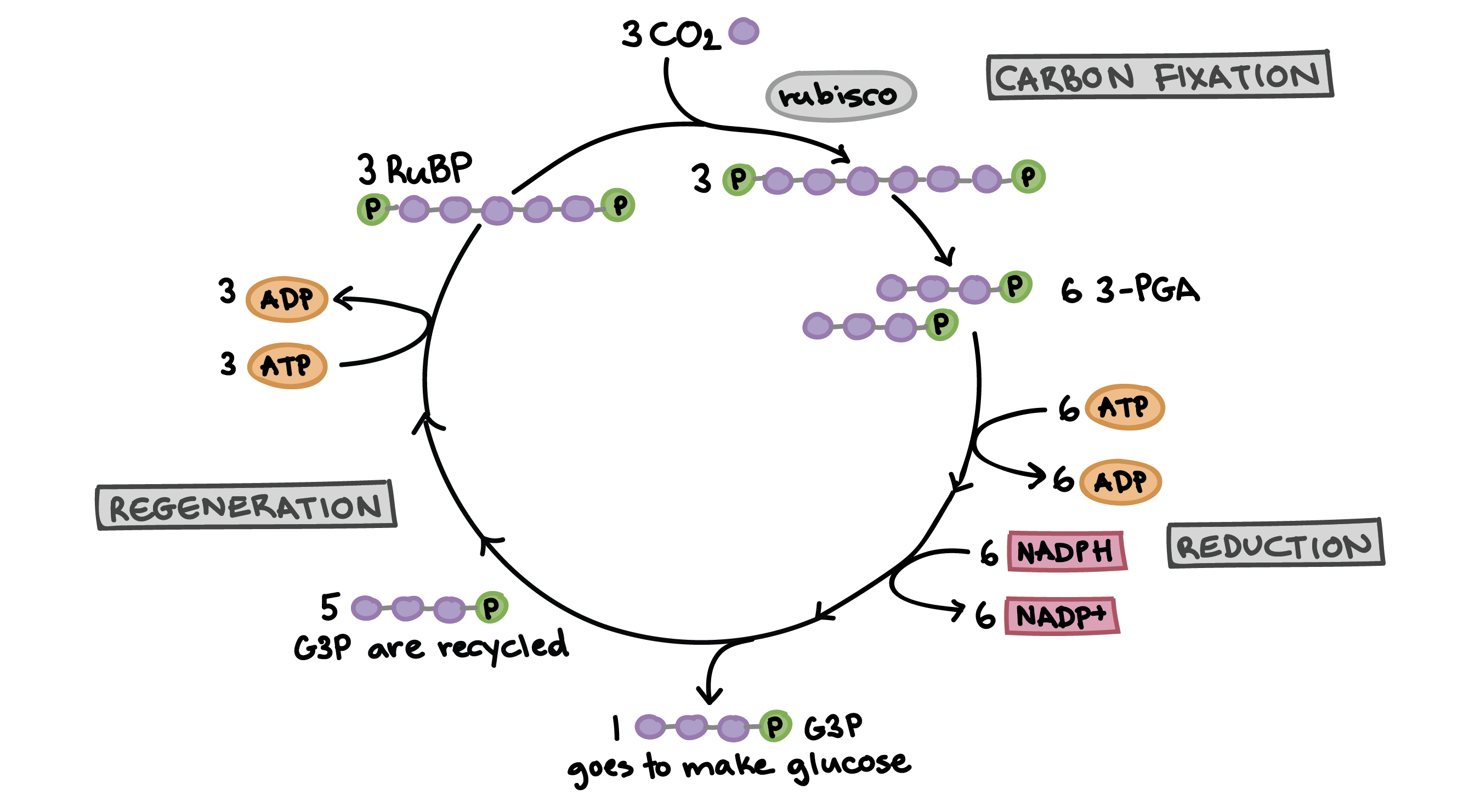
[See a diagram that shows the molecular structures]
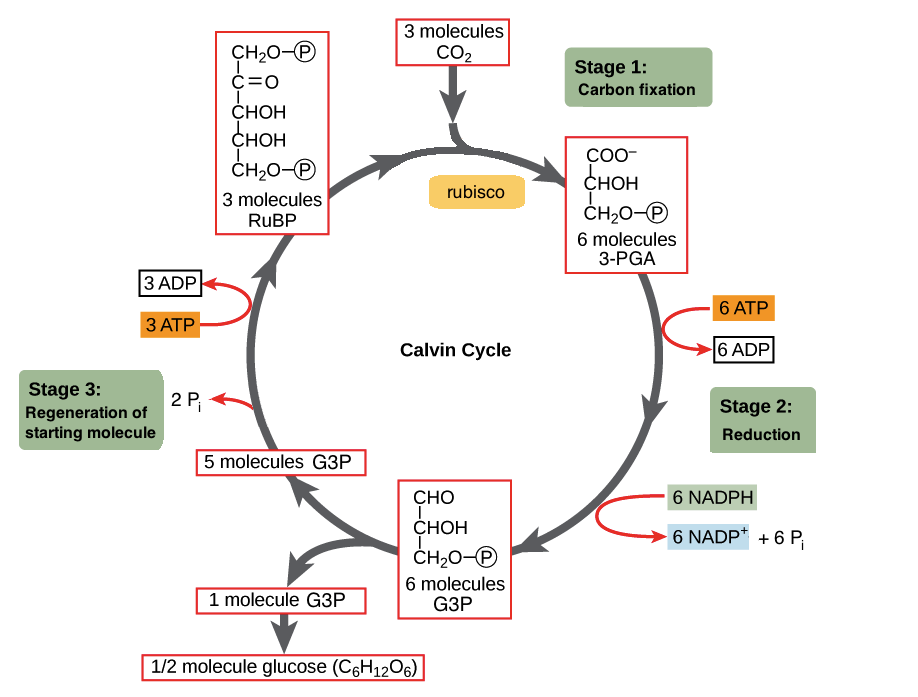
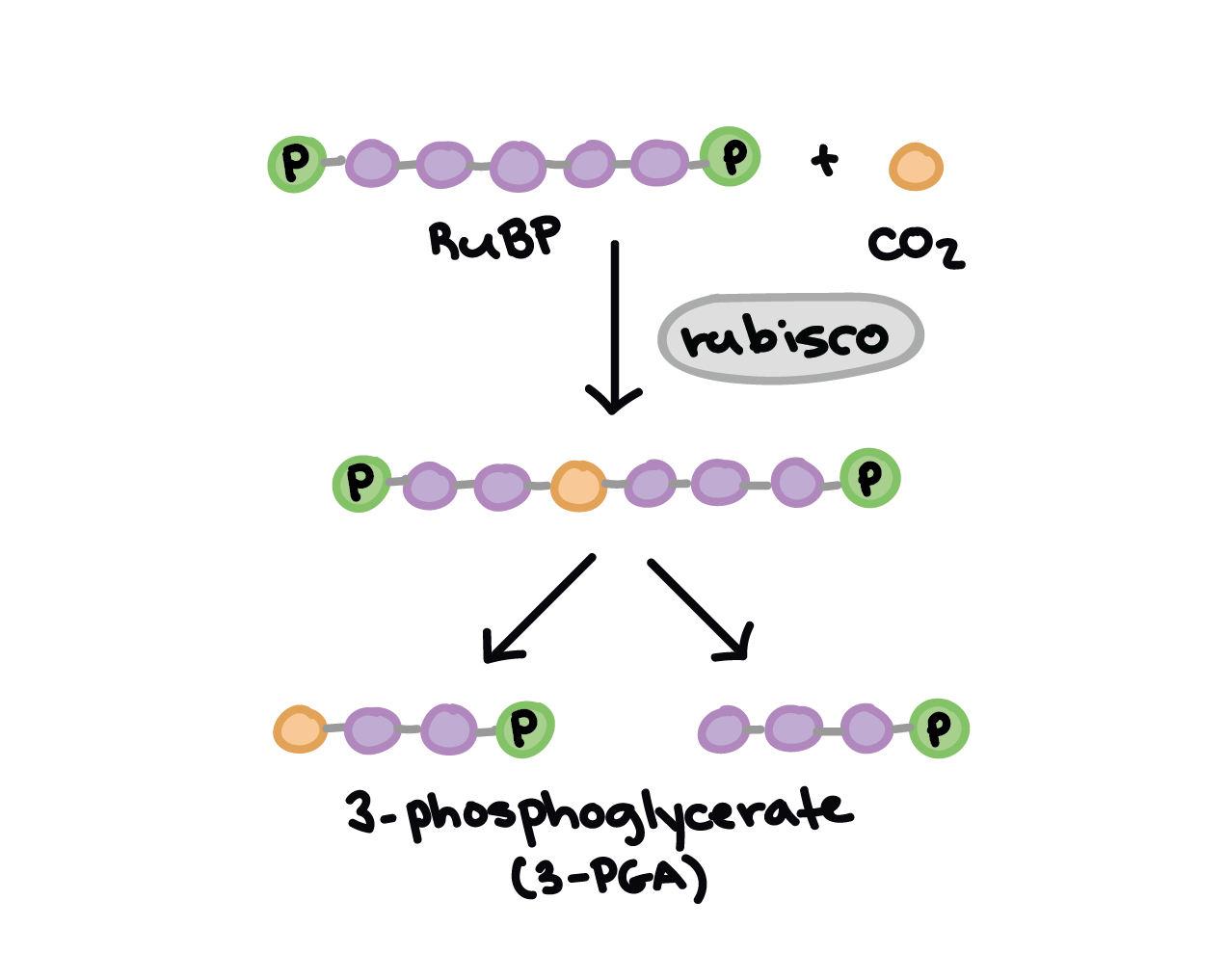
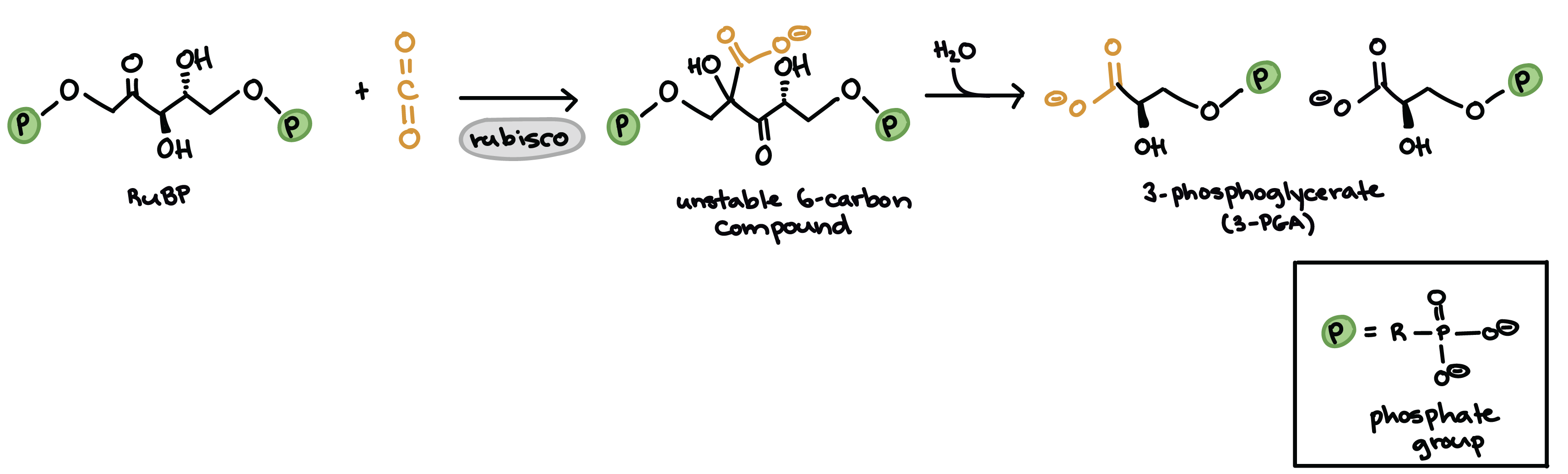
- Carbon fixation. A C, O, start subscript, 2, end subscript molecule combines with a five-carbon acceptor molecule, ribulose-1,5-bisphosphate (RuBP). This step makes a six-carbon compound that splits into two molecules of a three-carbon compound, 3-phosphoglyceric acid (3-PGA). This reaction is catalyzed by the enzyme RuBP carboxylase/oxygenase, or rubisco.
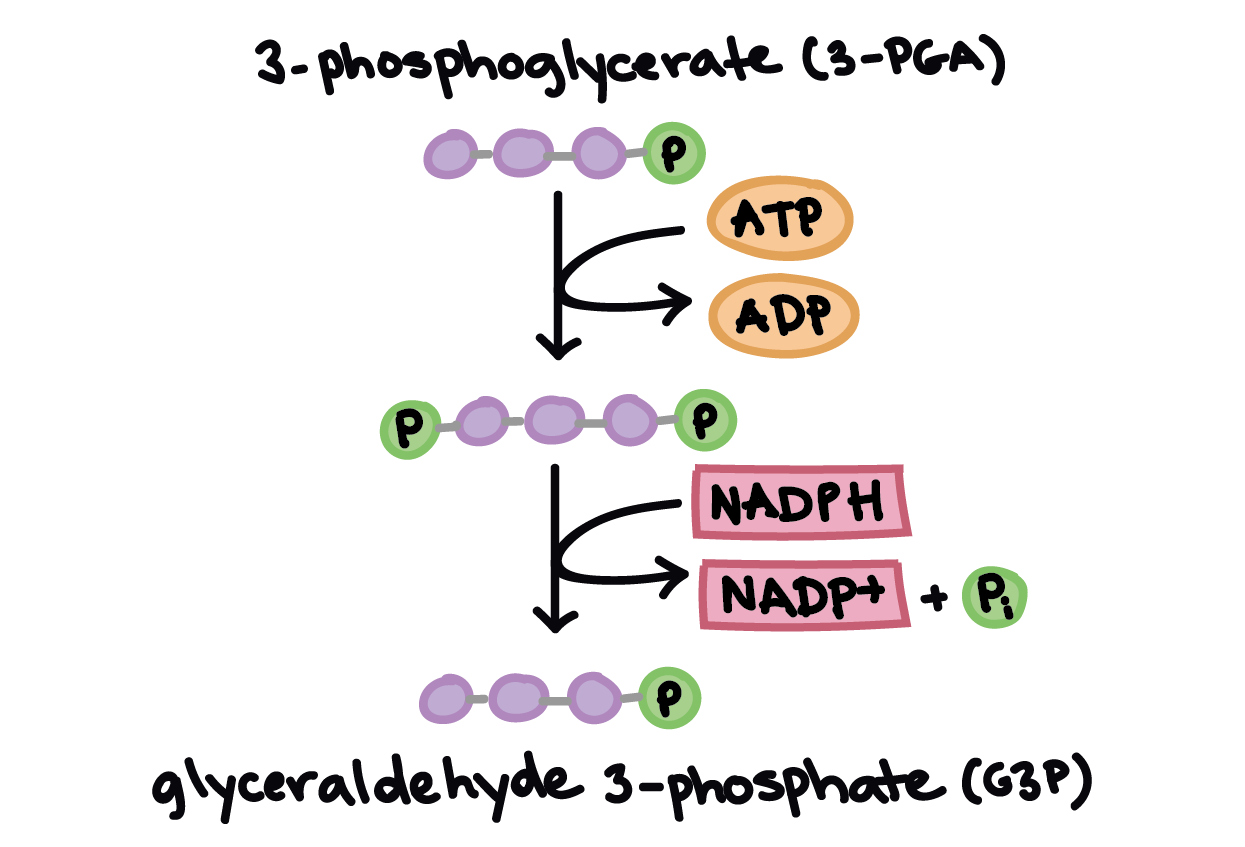
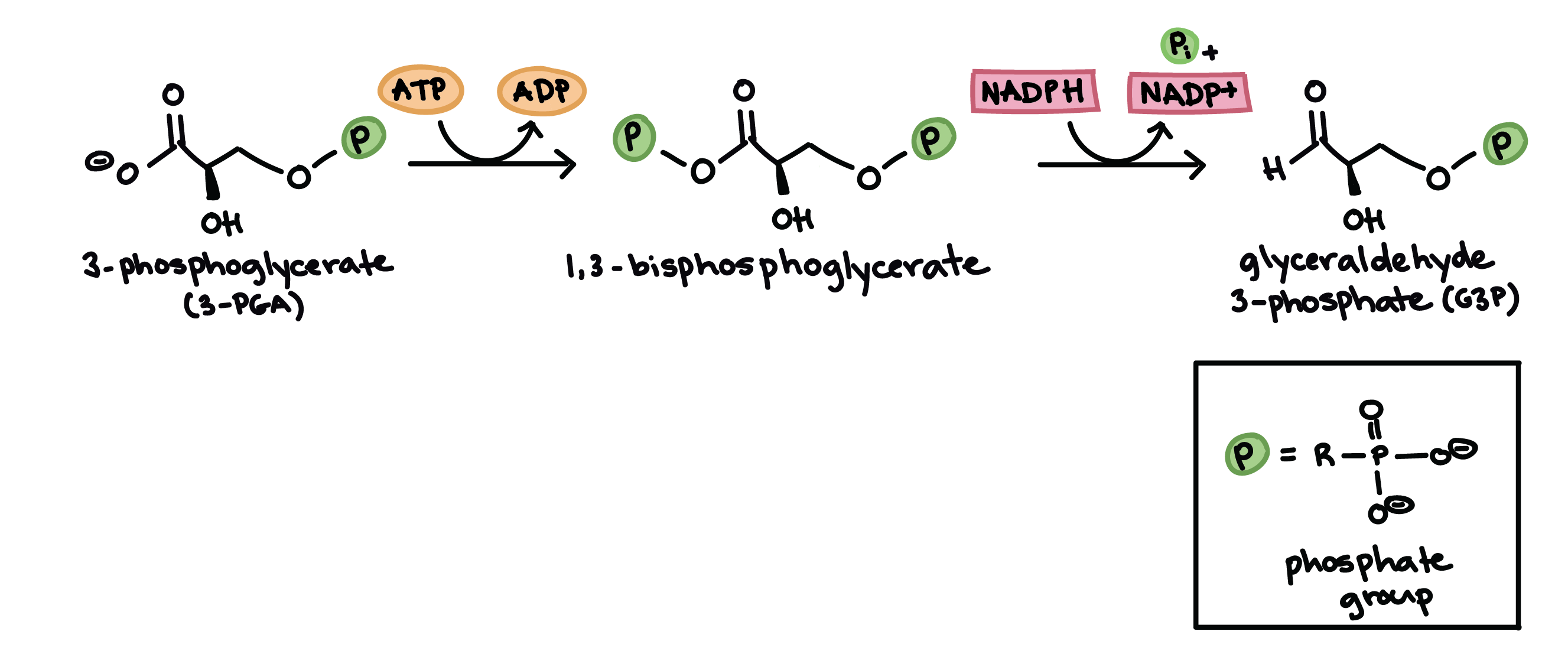
[Details of this step] - Reduction. In the second stage, ATP and NADPH are used to convert the 3-PGA molecules into molecules of a three-carbon sugar, glyceraldehyde-3-phosphate (G3P). This stage gets its name because NADPH donates electrons to, or reduces, a three-carbon intermediate to make G3P.
[Details of this step] - Regeneration. Some G3P molecules go to make glucose, while others must be recycled to regenerate the RuBP acceptor. Regeneration requires ATP and involves a complex network of reactions, which my college bio professor liked to call the "carbohydrate scramble." start superscript, 1, end superscript
In order for one G3P to exit the cycle (and go towards glucose synthesis), three C, O, start subscript, 2, end subscript molecules must enter the cycle, providing three new atoms of fixed carbon. When three C, O, start subscript, 2, end subscript molecules enter the cycle, six G3P molecules are made. One exits the cycle and is used to make glucose, while the other five must be recycled to regenerate three molecules of the RuBP acceptor.
Summary of Calvin cycle reactants and products
Three turns of the Calvin cycle are needed to make one G3P molecule that can exit the cycle and go towards making glucose. Let’s summarize the quantities of key molecules that enter and exit the Calvin cycle as one net G3P is made. In three turns of the Calvin cycle:
- Carbon. 3 C, O, start subscript, 2, end subscript combine with 3 RuBP acceptors, making 6 molecules of glyceraldehyde-3-phosphate (G3P).
- 1 G3P molecule exits the cycle and goes towards making glucose.
- 5 G3P molecules are recycled, regenerating 3 RuBP acceptor molecules.
- ATP. 9 ATP are converted to 9 ADP (6 during the fixation step, 3 during the regeneration step).
- NADPH. 6 NADPH are converted to 6 NADPstart superscript, plus, end superscript (during the reduction step).
A G3P molecule contains three fixed carbon atoms, so it takes two G3Ps to build a six-carbon glucose molecule. It would take six turns of the cycle, or 6C, O, start subscript, 2, end subscript, 18 ATP, and 12 NADPH, to produce one molecule of glucose.

Post A Comment:
0 comments so far,add yours